
Home › Downtown News › Training
TrainingWhat to wear to rugby: boots, mouthguards and gear for new players
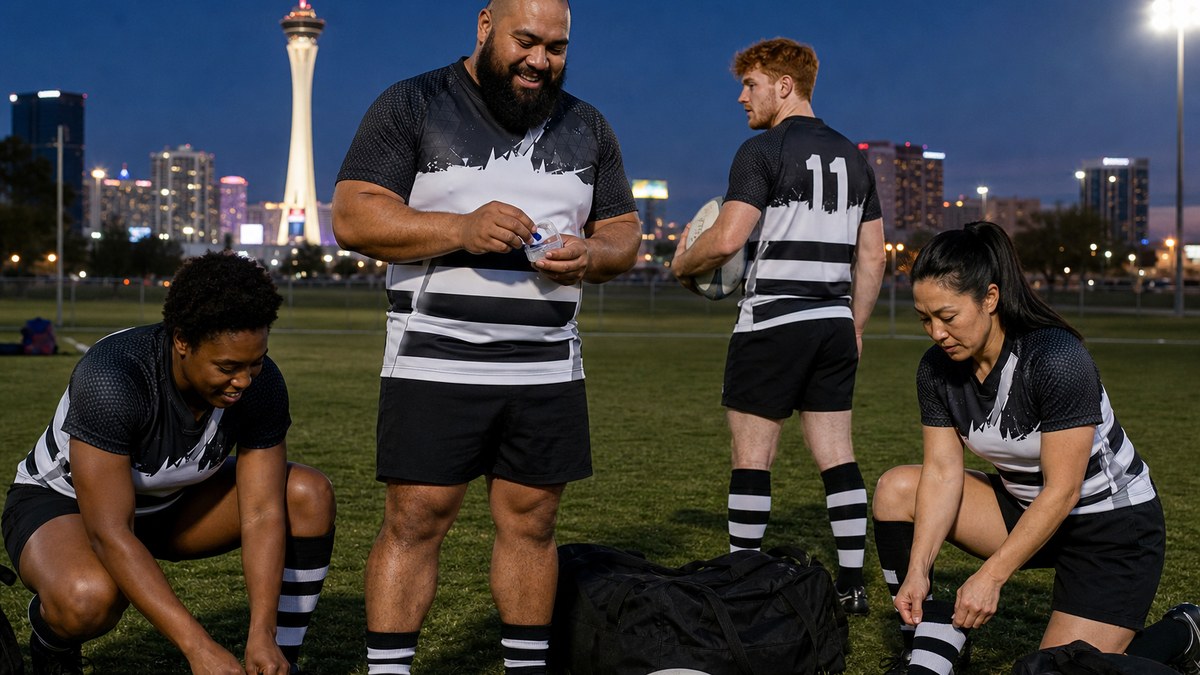
You don't need much to start playing rugby, but the few things you do need matter. Here is what to wear to your first touch session or contact training, what the laws allow, what to skip, and how to pack for an evening session in Las Vegas.
Key facts at a glance
- Required in contact rugby: a jersey, shorts, socks and boots (World Rugby Law 4)
- Mouthguard: "World Rugby recommends all players wear a mouthguard or dental protector" (Law 4)
- Stud length: no longer than 21 mm, with no burrs or sharp edges (World Rugby Rugby Ready, citing Regulation 12)
- Touch boots: soft moulded soles, studs no longer than 13 mm, no screw-in studs (England Touch)
- Banned: jewelry, gloves (fingerless mitts are allowed), anything sharp, rigid or with buckles and zips (Law 4)
- Headgear: allowed, but "there is no evidence that headgear provides protection against concussion" (World Rugby Rugby Ready)
The most common question we hear from people thinking about trying rugby isn't about the rules or fitness. It's "what do I wear?" It's a fair question. Rugby looks like a sport that needs a lot of equipment, and if you come from American football you might expect helmets and pads. The good news: rugby needs very little kit, and for your first session you probably own most of it already.
This guide covers what to wear to rugby as a beginner, format by format. It's built on World Rugby's own laws and safety guidance, England Touch's kit rules for touch, and the American Dental Association's advice on mouthguards, with every fact sourced at the bottom. If you're brand new, read it alongside our guides on how to start playing rugby as an adult and rugby rules for beginners.
What do you wear to your first rugby session?
It depends on the session. Most new players at Downtown Rugby start with touch rugby or a social session, then move into contact training if they want to. The kit list grows a little with each step, but not by much.
For touch or a beginner social session, wear what you'd wear for a run or a five-a-side game: a t-shirt or training top, athletic shorts, socks, and either running shoes or boots with short moulded studs. Bring water and a layer for after. World Rugby's own touch rugby laws say simply that "a player wears a jersey, vest or t-shirt and shorts," and that match organizers decide the right footwear.
For contact training, add proper rugby boots, a mouthguard, and kit you don't mind ripping or getting grass-stained. Shorts without pockets or zips and long socks are standard. A training top that fits close to the body is better than a baggy one, because loose fabric is easy to grab.
For a match, the team usually provides the jersey. World Rugby Law 4 sets out the basics every player wears: "a jersey, shorts and underwear, socks and boots." On top of that, a short list of extra items is allowed, which we cover below.
Don't buy a full kit before your first session. Turn up in running shoes, shorts and a t-shirt, play some touch, and ask around. Half the crew will have an opinion on boots, and someone usually has a spare pair of socks. Buy the boots and mouthguard once you know you're coming back.
What should beginners wear for each format?
Here is the kit we suggest for each way of playing. "Essential" means you shouldn't play without it; "optional" means it's your choice, within the laws.
| Item | Touch / tag | Contact training | Contact match (sevens, tens, fifteens) |
|---|---|---|---|
| Top | T-shirt or training top | Close-fitting training top | Team jersey (usually provided) |
| Shorts | Athletic shorts | Rugby shorts, no zips or pockets | Team shorts |
| Socks | Any sports socks | Long rugby socks | Team socks |
| Footwear | Running shoes or moulded studs (13 mm max at England Touch events) | Rugby boots, moulded or screw-in studs | Rugby boots; studs no longer than 21 mm |
| Mouthguard | Optional but sensible | Essential | Essential (recommended by World Rugby) |
| Headgear | Not needed | Optional, World Rugby approved | Optional, World Rugby approved |
| Padding | Not needed | Optional, approved only | Optional, approved only |
| Shin guards | Not allowed under World Rugby touch laws | Optional | Optional (thin padding only) |
| Jewelry | Remove it | Remove it | Banned |
| Water and a layer | Essential | Essential | Essential |
What boots do you need for rugby?
Boots are the one item worth getting right, because your feet are your grip on the ground. Rugby boots look like soccer cleats but are usually sturdier, with more support around the ankle and toe. Two stud types are common:
- Moulded studs: short, fixed rubber or plastic studs built into the sole. They work well on firm, dry ground and artificial turf, which describes most fields around Las Vegas for much of the year.
- Screw-in studs: longer, replaceable metal or alloy studs. They give more grip on soft or wet ground and are popular with forwards who need to push in scrums and mauls.
Whatever you choose, it has to be legal. World Rugby's Rugby Ready safety program says studs "must conform with World Rugby Specifications (Regulation 12)" and "must not be longer than 21mm, and must not have any burring or sharp edges." Check your studs before every session: worn screw-in studs can develop sharp edges that cut other players, and a referee can send you off to change them.
Touch has stricter rules. England Touch, the national body for touch in England, says "shoes with screw-in studs or cleats are not to be worn by any player," and allows "light leather or synthetic boots with soft moulded soles... provided individual studs are no longer than thirteen millimetres (13 mm) in length." Many touch players simply wear running shoes or turf shoes. In social sessions, the organizer decides, so ask before you show up in screw-ins.
Can you wear soccer cleats? For touch and early training, usually yes, as long as the studs are moulded and within the length limits. Some soccer boots have bladed studs; check that they have no sharp edges and that your league allows them. Once you're playing contact regularly, a proper rugby boot with more support is worth it.
Speed players care a lot about footwear too. The Vegas Lions go deep on acceleration in rugby speed training: how to win the first 10 meters, and grip is a big part of a fast start.

Do you need a mouthguard for rugby?
Yes, if there's any contact. World Rugby's Law 4 says: "World Rugby recommends all players wear a mouthguard or dental protector." Its Rugby Ready safety program goes further: "It is strongly recommended that all players wear a custom-made mouth guard during practice sessions and matches." Rugby Ready notes that mouthguards became compulsory in New Zealand in 1997 and points to a 47% reduction in rugby-related dental claims. Many clubs and competitions make them compulsory for contact, so treat a mouthguard as essential kit.
The American Dental Association describes three types:
- Stock: inexpensive and pre-formed, ready to wear, but they "often don't fit very well."
- Boil and bite: sold at sporting goods stores and drugstores. You soften it in hot water and bite into it so it shapes to your teeth. Always follow the manufacturer's instructions.
- Custom-made: made by your dentist from a mold of your teeth. The ADA says "the best mouthguard is one that has been custom made for your mouth by your dentist."
Most beginners start with a boil-and-bite and upgrade to a custom guard once they're committed. Look after it: the ADA advises rinsing it before and after use, storing it in a sturdy, vented case, replacing it if it's worn, damaged or loose, and never leaving it in the sun or in hot water. That last one matters in Las Vegas. A mouthguard left on a car dashboard in summer can warp, so keep it in your kit bag.
What are "smart" mouthguards?
You may have seen elite players wearing mouthguards with electronics inside. These instrumented mouthguards measure head acceleration and alert the match doctor when a player should have a head injury assessment. According to a RugbyPass report from April 9, 2024, the men's Six Nations was the first competition to use them, followed by the women's championship, and World Rugby's chief medical officer said a version that lights up to flag a possible concussion "could become a feature of the community game." For now, they're an elite-level tool. A well-fitted ordinary mouthguard is what beginners need.
A mouthguard you leave at home protects nobody. Buy two cheap boil-and-bites, keep one in your kit bag and one in your car's glovebox (not on the dash). You'll never miss a session for want of one.
Is headgear or padding worth it for beginners?
Headgear (often called a scrum cap) and thin shoulder or chest padding are both allowed in rugby, but neither is required, and neither turns rugby into a padded sport like American football.
Headgear: World Rugby's Rugby Ready is direct: "There is no evidence that headgear provides protection against concussion." It can help with cuts and ear injuries, which is why many forwards wear it. Rugby Ready also says head guards "are not recommended in all players" because they may encourage risk-taking. If you wear one, it must meet World Rugby's headgear specification and carry the approved-clothing label.
Padding: Law 4 allows shoulder pads or approved chest pads, and World Rugby Regulation 12 sets out exactly what's allowed. Rugby Ready says padding "does not protect against major injuries" and must be approved and labeled. Shorts or leggings with sewn-in padding are not allowed.
The real protection in rugby comes from technique: safe tackle height, good body position, and learning contact slowly. That's why every contact skill should be learned under a qualified coach. The Vegas Knights' guide on how to tackle in rugby safely explains why, and the Vegas Blackjacks cover scrum safety in scrum technique for props, hookers and locks.
Safety note: no item of kit makes contact rugby safe on its own. Learn tackling, rucking and scrummaging step by step under a qualified coach, and never play on with a suspected head injury. If you have a health condition or a past injury, check with your doctor before starting.
What can't you wear on a rugby field?
Law 4 is clear about banned items. You can't wear:
- Jewelry of any kind: rings, earrings, chains, watches, fitness bands that aren't approved monitoring devices. England Touch says items that can't be removed must be taped.
- Gloves. Fingerless mitts that meet Regulation 12 are allowed; full gloves are not.
- Anything sharp or abrasive, or items with "buckles, clips, rings, hinges, zippers, screws, bolts or rigid material or projection."
- Shorts or leggings with sewn-in padding.
- Communication devices.
- Blood-stained kit. If your jersey gets blood on it, you'll be asked to change it.
Long or sharp fingernails are also a problem: England Touch doesn't allow them. Glasses are trickier. In touch, England Touch allows glasses or sunglasses if they're "safe and securely attached." For contact, Law 4 allows goggles that meet World Rugby's specification, but regular glasses aren't a good idea. Talk to your coach if you need vision correction.
What's allowed but optional?
Law 4 lists a handful of extras you can wear if you want them:
- Washable elasticated or compression supports (for example, a knee or calf sleeve)
- Shin guards, with padding no thicker than 5 mm uncompressed (Regulation 12)
- Ankle supports under the socks, not metal if rigid
- Fingerless mitts
- Thin tape, bandages and dressings
- Cotton-blend long tights or leggings under shorts
- Headscarves that are not dangerous
- Approved goggles and approved player monitoring devices
In touch, World Rugby's leisure laws allow the same extras except shin pads. Base layers are popular on cool winter evenings in Las Vegas. Tape is everywhere in rugby: lineout jumpers tape their thighs, props tape their ears and fingers. You won't need any of that for your first few sessions.

How should you dress for rugby in the Las Vegas heat?
Las Vegas is a great place to play rugby most of the year, but the heat changes how you pack. The CDC lists athletes and people doing outdoor exercise and sports among the groups at higher risk from heat, and notes that "wearing personal protective equipment while working or playing may make people hotter." A few general habits help:
- Play in the evening. Downtown's summer touch is played in the evening, under the lights, for good reason. Don't schedule your own extra running for midday.
- Bring more water than you think. A big bottle per session, and drink before you arrive.
- Wear light, breathable layers for training, and skip optional padding or headgear in hot sessions unless you need it.
- Protect your kit too. Don't leave mouthguards, boots or water in a hot car.
- Check with your doctor if you have any health condition that heat affects. This is general advice, not medical advice.
Winter is the opposite problem. Evenings in the desert get cold fast, so a hoodie, a beanie and long pants for after the session make the third half much more comfortable.
Got the gear? Bring it to the APR Games
The APR Games 2027 run Memorial Day weekend, May 29–31, in Las Vegas: 10-a-side rugby, two 20-minute halves, evening kickoffs, with Men's Elite ($10,000 prize pool), Women's Social ($5,000) and Youth divisions. Player entry is $299 and includes a team jersey, kit bag, at least three pool games and opening-night access.
Join the APR Games waitlistWhat should be in your rugby kit bag?
Here's the checklist we'd give any new Downtown player. Pack it the night before and you'll never be the one borrowing socks:
- Boots (plus running shoes for touch or warm-ups)
- Mouthguard in a vented case
- Training top and a spare
- Shorts without zips or pockets
- Long socks and a spare pair
- Water bottle, full
- Warm layer for after: hoodie or jacket
- Towel and a plastic bag for muddy or sweaty kit
- Sports tape (optional, but handy)
- Change of clothes for the social afterward
If you want team gear, the APR merch store has kit from American Pro Rugby, and APR Games entry includes a team jersey and kit bag.
Item ten on that list is not a joke. Rugby has a "third half," the time after the game when both teams hang out together. Pack a clean shirt, because the best part of a Downtown session is often what happens after it.
How do you look after rugby gear?
Rugby kit takes a beating. A few habits keep it working longer:
- Boots: knock the mud off after every session, stuff them with newspaper to dry, and keep them out of direct sun and away from heaters. Check stud length and edges regularly, and replace worn screw-in studs.
- Mouthguard: rinse it, clean it in cool soapy water, let it dry in a vented case, and replace it when it's worn or no longer fits snugly.
- Jerseys and shorts: wash them cool and inside out, and wash bloodstained kit promptly.
- Headgear and padding: air them out after each use, and replace them if the padding breaks down or the approval label is no longer readable.
Where can you get started in Las Vegas?
Downtown Rugby runs social leagues, summer touch sessions and competitive squads for all levels, and complete beginners are welcome. You don't need to arrive with a full kit bag: bring the basics, and the crew will help with the rest.
- Join The Breakdown. Social league dates, touch sessions and training times go out first in The Breakdown, the free weekly newsletter from American Pro Rugby. It also breaks down one skill and one strength block each week.
- Start with touch. Running shoes, shorts, a t-shirt and water. That's all.
- Move into contact with a coach. Get boots and a mouthguard, and learn contact skills under a qualified coach. APR's coaching clinic runs May 28–31, 2027.
- Build your fitness steadily. The Vegas Kings' 6-week pre-season conditioning plan is a good next step once you're hooked.
Downtown is one of five founding franchises of American Pro Rugby, alongside the Vegas Kings, the Vegas Knights, the Vegas Blackjacks and the Vegas Lions. Meet them all on the APR teams page, catch up on the wider game on APR's global rugby news page, and see The Downtown Way for what we stand for. APR is backed by partners including Clann13, which makes supplements for athletes, and Luna Appleton, your guide to where to eat, stay and celebrate in Vegas when the third half moves downtown.
Frequently asked questions
What should I wear to my first rugby practice?
For touch or a beginner session, wear a t-shirt, athletic shorts, socks and running shoes or moulded-stud boots, and bring water and a warm layer. For contact training, add rugby boots and a mouthguard.
Do I need rugby boots to play rugby?
Not for your first touch session, where running shoes or short moulded studs are fine. For regular contact rugby, boots with legal studs give you the grip and support you need. World Rugby says studs must not be longer than 21 mm or have sharp edges.
Can I wear soccer cleats for rugby?
Usually yes for touch and early training, if the studs are moulded, short and have no sharp edges. Check with your organizer, because touch events often ban screw-in studs and limit stud length to 13 mm.
Is a mouthguard mandatory in rugby?
World Rugby's laws recommend that all players wear a mouthguard or dental protector, and many clubs and competitions require one for contact. Treat it as essential for any contact rugby.
What kind of mouthguard is best for rugby?
The American Dental Association says a custom-made mouthguard from your dentist gives the best fit. Boil-and-bite mouthguards are a good, affordable starting point for beginners.
Does rugby headgear prevent concussion?
No. World Rugby says there is no evidence that headgear protects against concussion. It can help with cuts and ear injuries, and it must meet World Rugby's specification if you wear it.
Can you wear jewelry when playing rugby?
No. Jewelry is banned under World Rugby Law 4. Remove rings, earrings, chains and watches before you play, and tape anything that can't be removed if your organizer allows it.
Can you wear gloves in rugby?
Full gloves are not allowed. Fingerless mitts that meet World Rugby Regulation 12 are permitted.
What do you wear for touch rugby?
A t-shirt or vest, shorts, socks, and running shoes or light boots with soft moulded studs. No screw-in studs, no jewelry and no shin pads under World Rugby's touch laws.
Where can I find Downtown Rugby session times?
Join The Breakdown, American Pro Rugby's free weekly newsletter, which carries Downtown Rugby's social league dates, touch sessions and training times first.
Keep reading
Sources
- World Rugby Passport: Law 4, Permitted clothing (accessed November 2026)
- World Rugby: Regulation 12, Provisions relating to players' dress (dated July 1, 2019)
- World Rugby Passport: Rugby Ready, equipment, environment and emergency plan (accessed November 2026)
- World Rugby Passport: Touch rugby, leisure rugby laws (accessed November 2026)
- England Touch: Equipment and kit (accessed November 2026)
- American Dental Association (MouthHealthy): Mouthguards (accessed November 2026)
- RugbyPass/PA: World Rugby reveal plans to improve tech for identifying concussion (April 9, 2024)
- CDC: Heat and health, clinical overview (reviewed September 18, 2025)
- American Pro Rugby: APR Games 2027
This guide is general information about rugby clothing and equipment as of November 2026, not medical, dental or coaching advice. Kit rules vary between unions, competitions and organizers: always check with your league before you play. Learn contact skills such as tackling, rucking and scrummaging under a qualified coach. If you have a health condition, check with your doctor before starting a new sport or training in the heat.